ASTRA × ADSENSE / 13 DAYS
GPT Astra, 21 public posts, and AdSense approval on the first attempt
The new Lab homepage created using GPT Astra had 21 public posts at the time of application, with 6 representative cases featured on the main page. A new subdomain was created under the existing company domain to build the homepage, and upon applying for the initial review, it was approved in just 13 days without reapplication.
The problem
I felt it would take too long to accumulate blog posts and increase web traffic before applying for AdSense approval. I wanted to organize what I had already done into content and start immediately on a new homepage.
My approach
GPT Astra organized my work materials into case study posts and created a homepage on the new subdomain. It continued with checking manuscripts, images, menus, and links.
What changed
I completed the new homepage using GPT Astra and received approval upon the first application. It took 13 days from the application on September 16 to approval on the 29th.

21 public posts · including 6 main representative cases · 13 days after first application
I felt it would take too long to accumulate blog posts, increase web traffic, and then apply for AdSense approval. I wanted to organize what I had already done into content and start immediately on a new homepage.
Using GPT Astra, I completed the new homepage and received approval upon first application. It took 13 days from the application on September 16 to approval on the 29th.
FROM REQUEST TO RESULT
How I made it work.
- 01
Using my experience as material
I collected directly created results and original materials such as PPT, HomeKit, and lecture tools.
- 02
Readable cases
I organized the problem, solution process, and results into short texts and actual images.
- 03
Site completed
I checked page and connection status, proceeded with error correction, and continued to the review application.
- 04
Approved after 13 days
It led from first application on September 16 to approval on September 29.
SMALL START / FIRST APPLICATION
The new Lab was approved before I built a large archive.
The company website already existed, but Lab was a new space. I turned my own work into cases, finished the site with an agent and submitted the first application.
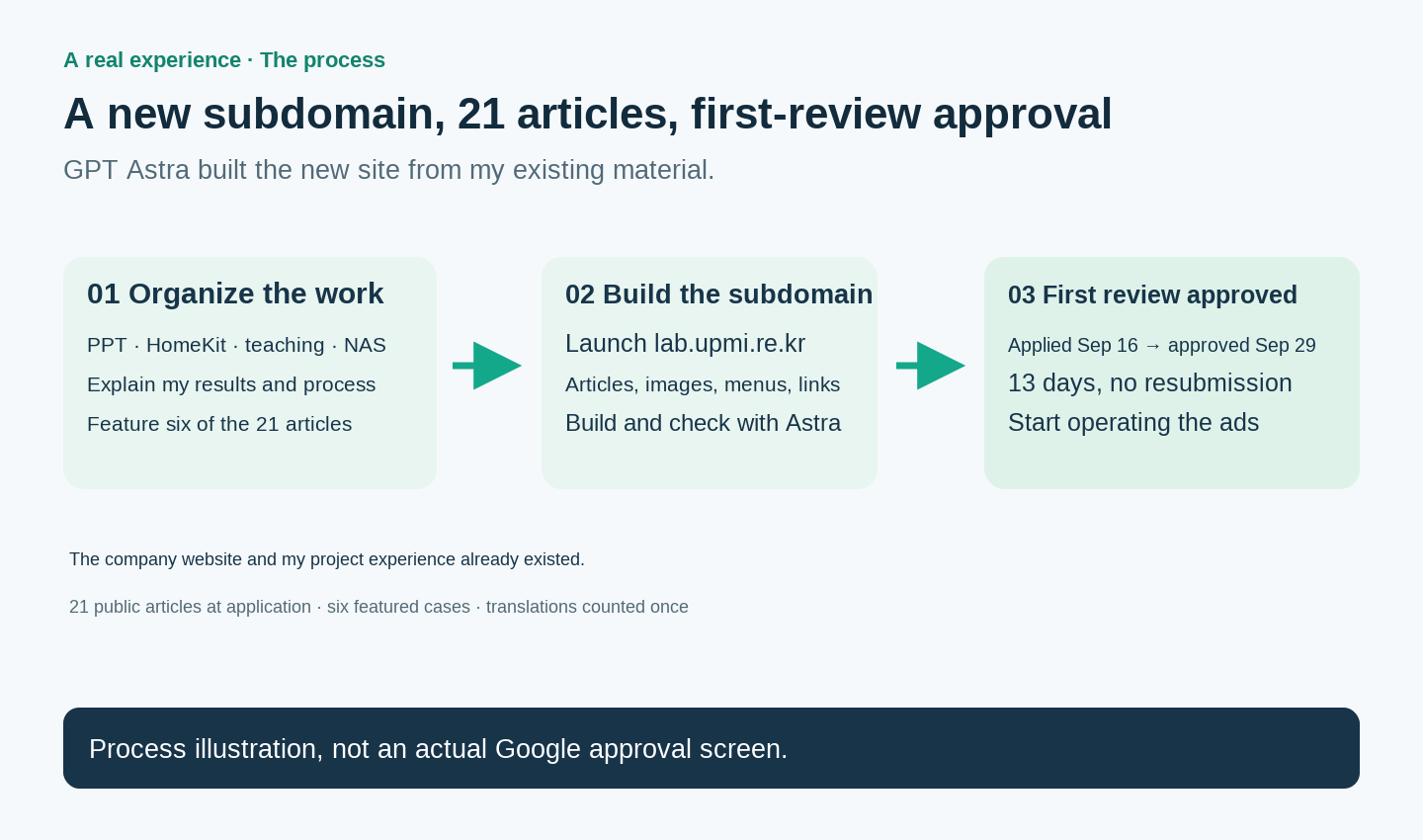
Select original work
I published 21 articles and featured six of them on the homepage.
Build a new Lab
I created a new subdomain site under the existing company domain and checked its content, images, navigation and links.
Pass the first review
Applied September 16, approved September 29: 13 days, without resubmission.
The reviewed domain was upmi.re.kr; the cases were at lab.upmi.re.kr. There were 21 public articles, including six homepage features, with translations counted once. The 13 days measure submission to approval.
COULD THIS WORK FOR YOU?
Could this work in your setup?
What should I prepare to create a site using my work records?
BUILD DETAILS
Build details & ideas to reuse
01I did not start with a site that had accumulated many posts
What I want to highlight from this experience is that a newly created homepage with limited content was approved upon the first application. Approval came sooner than my plan to increase blog traffic sufficiently and accumulate many posts before applying.
There were 21 published posts at the time of application, and among them, 6 representative cases such as PPT creation, HomeKit integration, lecture assistance, and NAS operation were introduced on the main screen. Korean and English translations were counted as the same post, and introduction, privacy notices, and external links were excluded. The current 7 items shown on the main page include this AdSense review added after approval.
02I switched existing materials to a new homepage
The company homepage upmi.re.kr already existed. I created lab.upmi.re.kr underneath it to use as a space for sharing my work experience. This was not purchasing a new domain, but creating a new content space using the existing domain.
I provided GPT Astra with the desired results and original materials, and it created case study manuscripts and images, Korean and English pages, menus, and links together. I checked introductions, privacy notices, mobile screens, and public accessibility, and also fixed documents that were not opening. Once I set the direction, GPT Astra continued to execute writing and site creation.
0313 days from first application to approval
I applied for review of upmi.re.kr as the target domain on September 16 and received approval on September 29. Case content was published on lab.upmi.re.kr. I passed the first review without any separate rejections or reapplications in between.
The 13 days refer to the period from application to approval. It does not mean that everything, including the existing company homepage and my past work, was created within 13 days. The achievement of this case is that a new homepage was quickly completed using GPT Astra and approved upon the first application.
04If I were to start over, the first thing I would do
I would first select things I have personally done and materials that can be made public. Instead of just increasing the number of posts, I would focus on creating understandable cases for readers and supporting explanations with actual screens or results. Then, I would check menus, links, and mobile screens before applying for review.
This experience is not a formula stating that "approval is guaranteed with just a few posts." Google's internal review reasons are unknown, and there was also an existing company site. However, I have the experience of a new homepage starting with 21 published posts being approved upon the first application. Now, the stage is to increase interested readers and make content more substantial.
Scope and things to consider
I counted based on the 21 published posts in the pre-release version just before the application on September 16 and the 6 representative cases on the main screen at that time. Representative cases are included in the total post count, so the 6 cases and 21 posts are not added together. The application and approval dates are based on work records and facts I verified. The diagram is not an actual Google approval screen.